Cart
0
How to Reconstitute Peptides With Bacteriostatic Water: A Complete Research Guide
Knowing how to reconstitute peptides correctly is one of the most fundamental skills in any peptide research workflow. Research peptides are shipped as a freeze-dried powder, and before they can be measured or used in a study, they must be dissolved back into a stable liquid solution. Done properly, reconstitution preserves the molecule's structure and gives you accurate, repeatable concentrations. Done badly, it can denature the peptide, ruin your concentration maths, and compromise an entire experiment.
This guide walks through the full process: the equipment you need, how to choose the right diluent, the correct step-by-step technique, how to calculate concentration, the mistakes to avoid, and how to store the solution afterwards. Everything below is written strictly for laboratory and in-vitro research use only.
What Does Reconstituting a Peptide Mean?
Reconstitution is the process of dissolving a lyophilised (freeze-dried) peptide powder back into a liquid using a sterile solvent. The dry "cake" or pellet you see at the bottom of a fresh vial is the pure peptide with all moisture removed. Adding a measured volume of diluent returns it to a usable solution and — crucially — lets you work out exactly how much peptide sits in each millilitre.
If you are new to handling these compounds, it's worth reading our broader guide to research peptides first to understand what peptides are and why they behave the way they do.
Why Peptides Are Supplied as Lyophilised Powder
Peptides are fragile molecules. In liquid form they degrade quickly through hydrolysis, oxidation, and microbial activity. Freeze-drying removes the water that drives those reactions, which is why suppliers ship dry powder rather than ready-made solution.
The stability difference is dramatic:
- Lyophilised powder: stable for roughly 24–36 months when stored at -20°C.
- Reconstituted solution: stable for only about 4–6 weeks, even when refrigerated.
In other words, the powder is the shelf-stable form and the solution is the perishable one. That single fact shapes every decision below — you reconstitute only what you intend to use, and you store the rest dry.
What You Need to Reconstitute Research Peptides
Gather everything before you start so you can work cleanly and without interruption. A typical reconstitution setup includes:
- Your peptide vial — the lyophilised powder, brought to room temperature.
- Bacteriostatic water — the standard diluent for most research peptides (more on this below).
- A sterile syringe — 1 ml insulin syringes (U100) are standard; use 2 ml if you're adding larger volumes.
- Alcohol wipes — 70% isopropyl alcohol for sterilising the rubber stoppers.
- A clean, draught-free workspace — wiped down and away from airflow to reduce contamination risk.
- Your concentration target — work out the maths before you add a single drop.
You can find sterile diluents, syringes, and wipes in our lab supplies collection.
Choosing the Right Diluent
The solvent you choose matters as much as the technique. The wrong diluent can leave a peptide partially undissolved or destroy its activity entirely. Here are the three you'll encounter most often.
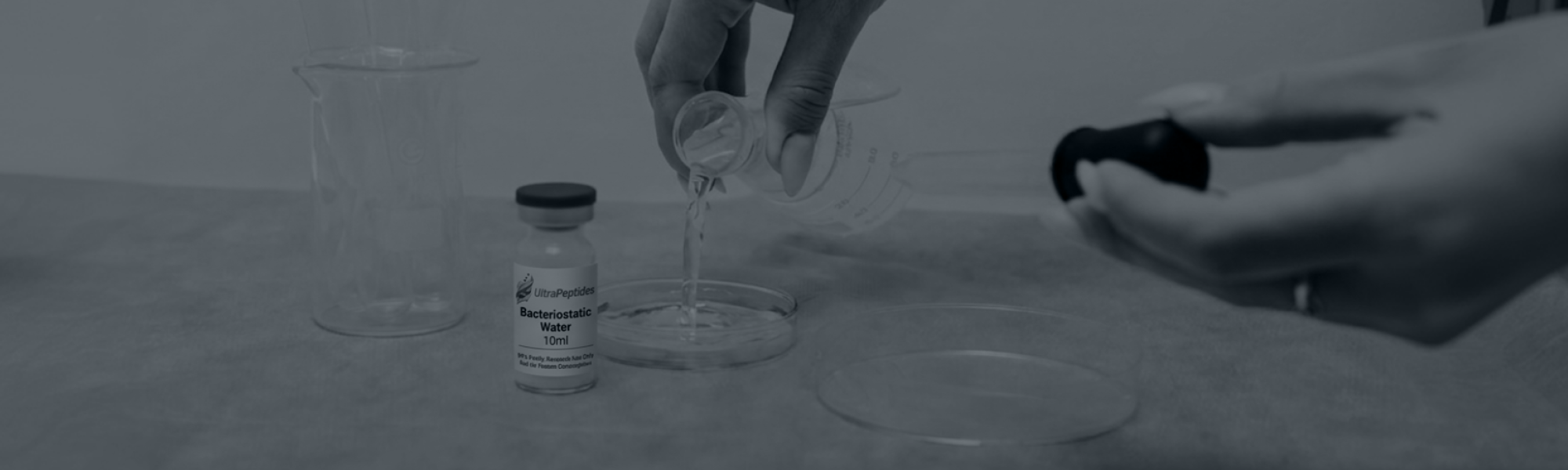
Bacteriostatic Water
Bacteriostatic water is sterile water containing 0.9% benzyl alcohol as a preservative. That preservative suppresses bacterial growth, which extends the usable life of the reconstituted solution to around 28 days when refrigerated. Because most research workflows involve drawing from the same vial repeatedly over days or weeks, bacteriostatic water is the default choice for the majority of peptides.
Sterile Water for Injection
Sterile water contains no preservative. It works for dissolving peptides but, once opened, the solution should be used within roughly 24 hours or split into single-use aliquots and frozen. It's best reserved for short-term work or for the small number of peptides that are sensitive to benzyl alcohol.
Acetic Acid and Specialised Solvents
Some hydrophobic or "sticky" peptides won't fully dissolve in water alone. These may need a dilute acetic acid solution (commonly around 1–2%, or up to a 50% aqueous solution for stubborn sequences) to break the cake down before being brought up to volume. Always check the specific compound's solubility guidance first.
| Diluent | Preservative | Refrigerated shelf life | Best for |
|---|---|---|---|
| Bacteriostatic water | Benzyl alcohol (0.9%) | ~28 days | Most peptides; repeated-use vials |
| Sterile water | None | ~24 hours (or aliquot & freeze) | Short-term work; benzyl-alcohol-sensitive peptides |
| Dilute acetic acid | None | Per protocol | Hydrophobic / poorly soluble peptides |
Note: A few short-sequence compounds (for example certain copper peptides or very short fragments) can be sensitive to benzyl alcohol. Always check the storage notes for your specific peptide before defaulting to bacteriostatic water.
How to Reconstitute Peptides: Step-by-Step
Once your workspace and maths are ready, the procedure itself is quick. Work slowly and gently — peptides are damaged by force, not by patience.
- Bring both vials to room temperature. Take the peptide and the bacteriostatic water out of storage and let them sit for 5–10 minutes. Adding cold solvent to a cold vial encourages cloudiness and condensation.
- Sterilise the stoppers. Wipe the rubber tops of both vials with a 70% alcohol wipe and let them air-dry for 10–15 seconds. Don't wipe the alcohol off.
- Equalise the pressure (optional but helpful). Lyophilised vials can hold a slight vacuum or positive pressure. Inserting a needle half-filled with air lets the vial stabilise, which prevents solution loss through the stopper.
- Draw your diluent. Pull back the syringe plunger to draw air equal to your target volume, inject that air into the bacteriostatic water vial, invert it, and withdraw the exact volume you calculated.
- Add the water slowly, down the glass. Insert the needle into the peptide vial at a slight angle and aim the stream against the inside wall of the glass — never directly onto the powder cake. Push the plunger slowly to avoid foaming.
- Dissolve gently. Withdraw the needle and swirl or roll the vial gently between your hands. Never shake it. If the cake is slow to dissolve, let the vial sit undisturbed for 15–30 minutes.
- Inspect the solution. A correctly reconstituted peptide should be completely clear and free of particles. If it's cloudy, discoloured, or has visible debris, discard it.
For a worked example using a specific compound, see our dedicated walkthrough on how to properly mix BPC-157 for research purposes.
Calculating Peptide Concentration
This is the step researchers most often get wrong. The volume of water you add determines the concentration of every measurement you take afterwards, so the maths has to be right.
The core relationship is simple:
Concentration (mg/ml) = Peptide amount (mg) ÷ Diluent volume (ml)
The table below shows how the same 10 mg vial gives very different concentrations depending on how much water you add:
| Peptide in vial | Bacteriostatic water added | Final concentration |
|---|---|---|
| 10 mg | 1 ml | 10 mg/ml |
| 10 mg | 2 ml | 5 mg/ml |
| 10 mg | 5 ml | 2 mg/ml |
A useful rule of thumb is to keep total reconstitution volume between roughly 1 ml and 2.5 ml unless a specific protocol calls for more — excessive dilution can compromise peptide integrity and makes accurate measurement harder.
Rather than working these figures out by hand every time, run them through our free peptide calculator, which handles mg, mcg, and IU conversions and removes the risk of an arithmetic slip ruining your results.
Common Reconstitution Mistakes to Avoid
Most reconstitution failures come down to a handful of avoidable errors:
- Shaking the vial. Agitation causes foaming and shears the peptide, leading to aggregation and degradation. Always swirl, never shake.
- Spraying water onto the powder. Hitting the cake directly with a fast stream can damage the molecule. Aim for the glass wall.
- Using cold vials. Cold-to-cold mixing causes cloudiness and inconsistent dissolution. Let everything reach room temperature first.
- Skipping sterilisation. Unwiped stoppers introduce contamination that the preservative can't always control.
- Guessing the volume. Without doing the concentration maths first, every downstream measurement is unreliable.
- Reconstituting too much at once. Solution degrades far faster than powder, so only prepare what you'll use within the stability window.
Storing Reconstituted Peptides
Once a peptide is in solution the clock starts ticking. To preserve it for as long as possible:
- Store reconstituted solutions at 2–8°C (standard refrigeration).
- With bacteriostatic water, most peptides stay stable for around 4–6 weeks.
- Solutions made with plain sterile water should be used within 24 hours, or split into single-use aliquots and frozen.
- Keep vials away from light and avoid repeated freeze–thaw cycles, which are particularly damaging.
Storage conditions and pH both have a major influence on how long a solution lasts. For a deeper look at degradation factors and to model your own peptide's shelf life, see our peptide stability and pH calculator guide.
Reconstitution Quick-Reference
| Stage | Key rule |
|---|---|
| Temperature | Room temperature before mixing |
| Sterilising | 70% alcohol wipe, air-dry, don't wipe off |
| Adding water | Slowly, down the glass wall — never onto the powder |
| Mixing | Swirl or roll gently — never shake |
| Inspection | Clear solution only; discard if cloudy |
| Concentration | mg ÷ ml = mg/ml (use the calculator) |
| Storage | 2–8°C; ~28 days with bacteriostatic water |
Frequently Asked Questions
How much bacteriostatic water should I use to reconstitute a peptide?
It depends on the concentration you want. Most researchers add between 1 ml and 2.5 ml per vial. Use the peptide calculator to match your water volume to your target concentration.
Can I use tap water or normal sterile water instead of bacteriostatic water?
Never use tap water. Plain sterile water works for short-term use but has no preservative, so the solution must be used within about 24 hours. Bacteriostatic water is preferred for vials accessed repeatedly over several weeks.
Why shouldn't I shake the vial?
Shaking introduces air and shearing force that cause the peptide to foam, aggregate, and degrade. Gentle swirling or rolling dissolves the cake without damaging the molecule.
How long does a reconstituted peptide last?
Reconstituted with bacteriostatic water and refrigerated at 2–8°C, most peptides remain stable for roughly 4–6 weeks. Lyophilised powder stored at -20°C lasts far longer — up to 24–36 months.
What should the solution look like when it's done correctly?
Completely clear and free of particles. Any cloudiness, discolouration, or visible debris means the solution should be discarded.
Final Thoughts
Reconstitution is a straightforward procedure, but it's also the foundation that every accurate result is built on. Bring your vials to room temperature, choose the right diluent, add water slowly down the glass, swirl gently, and always do your concentration maths first. Get those fundamentals right and your peptides stay intact and your measurements stay reliable.
Ready to start your next study? Browse our range of high-purity research peptides and lab supplies, all lab-tested to over 99% purity and dispatched across the UK.
Note: All products and information are intended strictly for laboratory and in-vitro research use only. Nothing in this article is medical advice, and research peptides are not for human consumption.